
ASME BPVC 2025 Section X: Fiber-Reinforced Plastic Pressure Vessels
Original price was: $609.00.$203.00Current price is: $203.00.
ASME BPVC 2025 Section X covers construction requirements for fiber-reinforced plastic (FRP) pressure vessels, including design bases, materials, fabrication, inspection, testing, and qualification by prototype testing (Classes I & III) or by mandatory design rules with nondestructive examination (Class II).
ASME BPVC 2025 Section X covers construction requirements for fiber-reinforced plastic (FRP) pressure vessels, including design bases, materials, fabrication, inspection, testing, and qualification by prototype testing (Classes I & III) or by mandatory design rules with nondestructive examination (Class II).
Book information
Purchase now to read the book instantly.
Add to cartRelated products
AWS D17.3/D17.3M:2016 – Specification for Friction Stir Welding of Aluminum Alloys for Aerospace Applications
AWS D17.3/D17.3M:2016 establishes general requirements for the friction stir welding (FSW) of aluminum alloys in aerospace applications. It provides standardized procedures for the design, fabrication, qualification, and inspection of aerospace components joined using the FSW process.
Highlights:
- Design requirements for FSW joints in aerospace structures
- Qualification procedures for welders, operators, and welding procedures
- Approved base metal specifications and usage limitations
- Tooling, fixture, and FSW equipment setup requirements
- Fabrication guidelines for welding parameters and process control
- Visual and mechanical inspection methods for weld quality verification
- Acceptance criteria for discontinuities, mechanical properties, and visual appearance
- Quality assurance provisions, documentation, and recordkeeping standards
New in the 2016 Edition:
- Updates to reflect advancements in friction stir welding techniques and aerospace material performance
- Enhanced inspection and qualification procedures for improved compliance and reliability
- Supersedes AWS D17.3/D17.3M:2010
Who’s It For:
Aerospace engineers, quality professionals, and fabricators involved in the production or qualification of aluminum structures using friction stir welding.
AWS D17.3/D17.3M-2016
AWS D17.3/D17.3M:2016 – Specification for Friction Stir Welding of Aluminum Alloys for Aerospace Applications
AWS D17.3/D17.3M:2016 establishes general requirements for the friction stir welding (FSW) of aluminum alloys in aerospace applications. It provides standardized procedures for the design, fabrication, qualification, and inspection of aerospace components joined using the FSW process.
Highlights:
- Design requirements for FSW joints in aerospace structures
- Qualification procedures for welders, operators, and welding procedures
- Approved base metal specifications and usage limitations
- Tooling, fixture, and FSW equipment setup requirements
- Fabrication guidelines for welding parameters and process control
- Visual and mechanical inspection methods for weld quality verification
- Acceptance criteria for discontinuities, mechanical properties, and visual appearance
- Quality assurance provisions, documentation, and recordkeeping standards
New in the 2016 Edition:
- Updates to reflect advancements in friction stir welding techniques and aerospace material performance
- Enhanced inspection and qualification procedures for improved compliance and reliability
- Supersedes AWS D17.3/D17.3M:2010
Who’s It For:
Aerospace engineers, quality professionals, and fabricators involved in the production or qualification of aluminum structures using friction stir welding.
AWS D17.3/D17.3M-2016
2021 International Fuel Gas Code – IFGC-2021
The 2021 International Fuel Gas Code® (IFGC) provides comprehensive requirements for the design and installation of fuel gas systems in residential, commercial, and industrial buildings. It governs piping, appliances, combustion air, chimneys, vents, and gaseous hydrogen systems, ensuring safe and efficient fuel gas usage across all occupancies. Fully aligned with the 2021 I-Code suite.
Highlights:
- Regulates natural gas systems up to 125 psig and LP-gas up to 20 psig from point of delivery to appliance shutoff
- Includes complete standards for gaseous hydrogen systems in Chapter 7
- Covers installation, combustion air, and venting for a wide range of fuel gas appliances
- Supports both prescriptive and engineered design methods for air supply, venting, and pipe sizing
- Provides appendices for gas pipe and vent sizing, inspection procedures, and appeals processes
- References updated technical standards from ASME, ANSI, AGA, CSA, and NFPA
- Revised administration chapter clarifies enforcement roles, jurisdictional edits, and appeals
Who It’s For:
Mechanical engineers, gas system designers, inspectors, code officials, and utility providers responsible for safe and compliant gas system installations.
IFGC-2021
2021 International Fuel Gas Code – IFGC-2021
The 2021 International Fuel Gas Code® (IFGC) provides comprehensive requirements for the design and installation of fuel gas systems in residential, commercial, and industrial buildings. It governs piping, appliances, combustion air, chimneys, vents, and gaseous hydrogen systems, ensuring safe and efficient fuel gas usage across all occupancies. Fully aligned with the 2021 I-Code suite.
Highlights:
- Regulates natural gas systems up to 125 psig and LP-gas up to 20 psig from point of delivery to appliance shutoff
- Includes complete standards for gaseous hydrogen systems in Chapter 7
- Covers installation, combustion air, and venting for a wide range of fuel gas appliances
- Supports both prescriptive and engineered design methods for air supply, venting, and pipe sizing
- Provides appendices for gas pipe and vent sizing, inspection procedures, and appeals processes
- References updated technical standards from ASME, ANSI, AGA, CSA, and NFPA
- Revised administration chapter clarifies enforcement roles, jurisdictional edits, and appeals
Who It’s For:
Mechanical engineers, gas system designers, inspectors, code officials, and utility providers responsible for safe and compliant gas system installations.
IFGC-2021
ASME PTB-4-2021: ASME Section VIII – Division 1 Example Problem Manual
ASME PTB-4-2021: ASME Section VIII – Division 1 Example Problem Manual presents a comprehensive set of solved example problems demonstrating the correct application of design-by-rule methods from ASME Boiler and Pressure Vessel Code, Section VIII, Division 1. It serves as a valuable learning and reference tool for engineers, designers, and inspectors working in pressure vessel design and analysis.
Highlights:
- Step-by-step examples covering material selection, MDMT, welded joints, and reinforcement
- Calculations for internal/external pressure, flange design, tubesheets, and expansion joints
- Integration of Mandatory Appendix 46 for using Division 2 methods within Division 1 design
- Comparison of Division 1 and Division 2 approaches to selected design problems
- Commentary offering insight into code interpretation and design rationale
- Dual-unit presentation: U.S. Customary and SI
- Examples include postweld heat treatment, hydrotesting, out-of-roundness, and NDE procedures
- Supports design-by-rule and design-by-analysis education and application
Who It’s For:
Mechanical engineers, vessel designers, educators, and code compliance professionals seeking hands-on understanding and accurate application of ASME Section VIII, Division 1 requirements.
PTB-4-2021
ASME PTB-4-2021: ASME Section VIII – Division 1 Example Problem Manual
ASME PTB-4-2021: ASME Section VIII – Division 1 Example Problem Manual presents a comprehensive set of solved example problems demonstrating the correct application of design-by-rule methods from ASME Boiler and Pressure Vessel Code, Section VIII, Division 1. It serves as a valuable learning and reference tool for engineers, designers, and inspectors working in pressure vessel design and analysis.
Highlights:
- Step-by-step examples covering material selection, MDMT, welded joints, and reinforcement
- Calculations for internal/external pressure, flange design, tubesheets, and expansion joints
- Integration of Mandatory Appendix 46 for using Division 2 methods within Division 1 design
- Comparison of Division 1 and Division 2 approaches to selected design problems
- Commentary offering insight into code interpretation and design rationale
- Dual-unit presentation: U.S. Customary and SI
- Examples include postweld heat treatment, hydrotesting, out-of-roundness, and NDE procedures
- Supports design-by-rule and design-by-analysis education and application
Who It’s For:
Mechanical engineers, vessel designers, educators, and code compliance professionals seeking hands-on understanding and accurate application of ASME Section VIII, Division 1 requirements.
PTB-4-2021
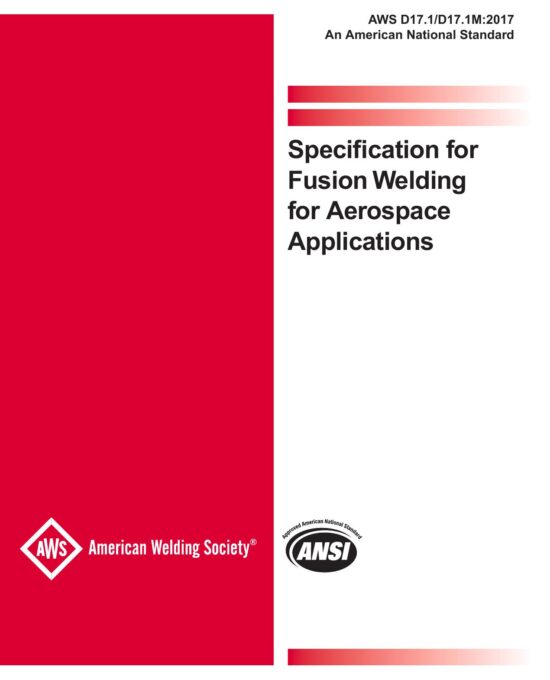
AWS D17.1/D17.1M:2017 – Specification for Fusion Welding for Aerospace Applications
AWS D17.1/D17.1M:2017 establishes the welding requirements for aircraft, aerospace, and space hardware using electric arc and high-energy beam fusion welding processes. It covers aluminum, nickel, iron, cobalt, titanium, and magnesium alloys and supports both flight-critical and support structure applications.
Highlights:
- Design criteria for aerospace weld joints
- Qualification requirements for procedures and personnel
- Fabrication, inspection, and acceptance standards
- Repair guidance for aerospace components
- Preweld/postweld processes including traceability and cleaning
- Visual and nondestructive exam methods with acceptance criteria
- Normative/informative annexes on bend tests, positions, acronyms, and forms
- Commentary with technical interpretation and best practices
New in the 2017 Edition:
- Annexes for UNS material designations
- Expanded welding position coverage and standardized forms
- Editorial updates for clarity and usability
Who’s It For:
Aerospace engineers, welding supervisors, inspectors, and quality professionals involved in the fabrication or evaluation of welded aerospace structures.
AWS D17.1/D17.1M-2017
AWS D17.1/D17.1M:2017 – Specification for Fusion Welding for Aerospace Applications
AWS D17.1/D17.1M:2017 establishes the welding requirements for aircraft, aerospace, and space hardware using electric arc and high-energy beam fusion welding processes. It covers aluminum, nickel, iron, cobalt, titanium, and magnesium alloys and supports both flight-critical and support structure applications.
Highlights:
- Design criteria for aerospace weld joints
- Qualification requirements for procedures and personnel
- Fabrication, inspection, and acceptance standards
- Repair guidance for aerospace components
- Preweld/postweld processes including traceability and cleaning
- Visual and nondestructive exam methods with acceptance criteria
- Normative/informative annexes on bend tests, positions, acronyms, and forms
- Commentary with technical interpretation and best practices
New in the 2017 Edition:
- Annexes for UNS material designations
- Expanded welding position coverage and standardized forms
- Editorial updates for clarity and usability
Who’s It For:
Aerospace engineers, welding supervisors, inspectors, and quality professionals involved in the fabrication or evaluation of welded aerospace structures.
AWS D17.1/D17.1M-2017