
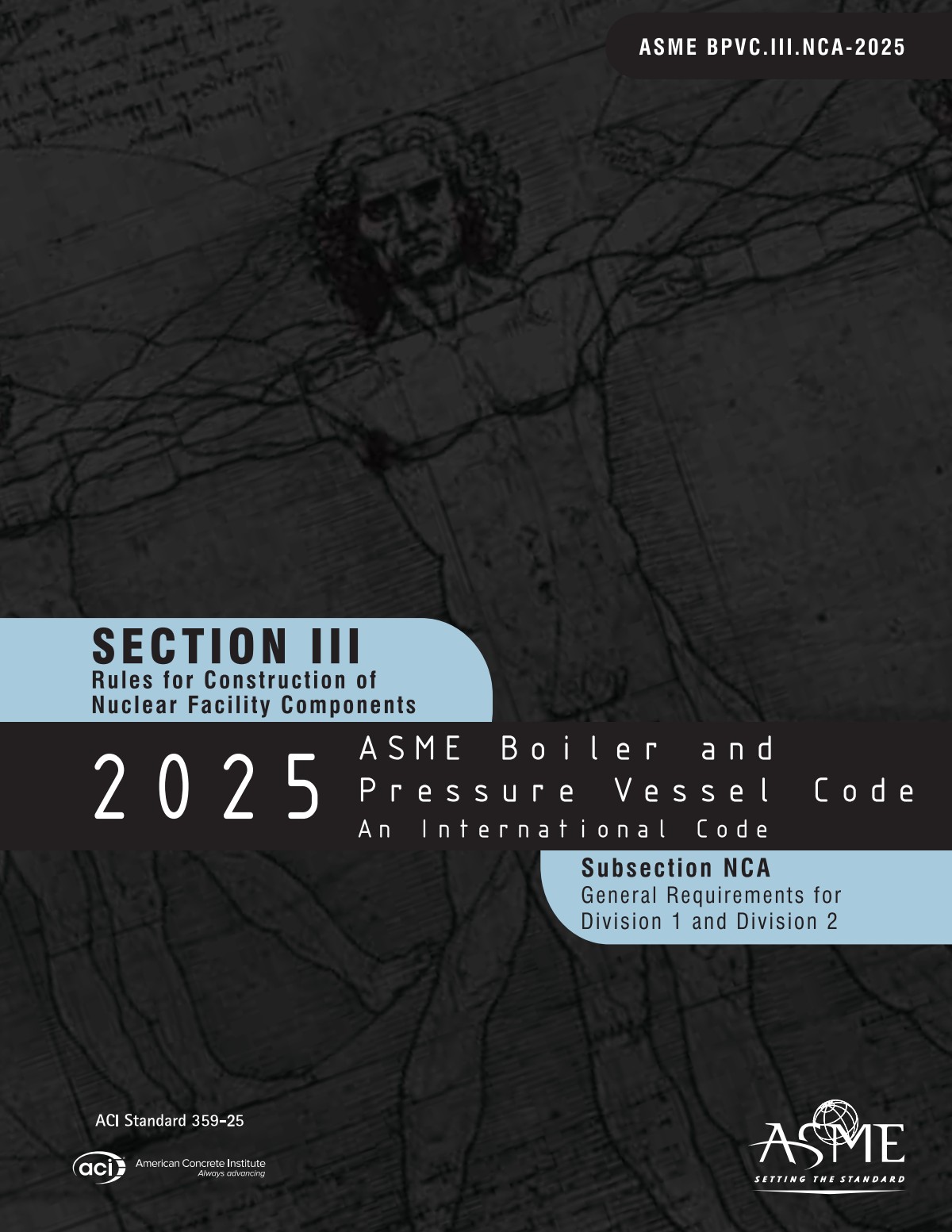
ASME BPVC 2025 Section III, Subsection NCA: General Requirements for Division 1
Original price was: $783.00.$261.00Current price is: $261.00.
ASME BPVC 2025 Section III, Subsection NCA covers the general requirements applicable to nuclear facility components in Division 1, including administrative, material, and design rules. This subsection provides the foundational framework governing Subsections NB, NC, and ND, ensuring consistent construction standards for safety-critical nuclear applications.
ASME BPVC 2025 Section III, Subsection NCA covers the general requirements applicable to nuclear facility components in Division 1, including administrative, material, and design rules. This subsection provides the foundational framework governing Subsections NB, NC, and ND, ensuring consistent construction standards for safety-critical nuclear applications.
Book information
Purchase now to read the book instantly.
Add to cartRelated products
AWS D1.6/D1.6M:2017 – Structural Welding Code – Stainless Steel
AWS D1.6/D1.6M:2017 – Structural Welding Code – Stainless Steel defines the welding requirements for austenitic and ferritic stainless steel structural components. Applicable to both shop and field fabrication, it governs the construction of non-pressure stainless steel structures and aligns closely with AWS D1.1 formatting for consistency.
Highlights:
- Design provisions for welded joints and structural connection details
- Specifications for base metals, filler materials, and qualified welding processes
- Prequalification criteria for procedures and joint configurations
- Qualification standards for welding procedures, welders, and operators
- Visual and nondestructive inspection methods
- Stud welding practices and performance qualification requirements
- Fabrication standards for cleaning, joint prep, and weld profile control
- Weld acceptance criteria and repair guidelines
- Normative and informative annexes on weld sizing, filler metal selection, sample forms, and macroetchants
- Commentary section offering interpretation and application guidance
Who It’s For:
Essential for fabricators, engineers, inspectors, and contractors involved in stainless steel construction for structural applications such as architectural systems, industrial frameworks, and corrosion-resistant environments.
AWS D1.6/D1.6M:2017
AWS D1.6/D1.6M:2017 – Structural Welding Code – Stainless Steel
AWS D1.6/D1.6M:2017 – Structural Welding Code – Stainless Steel defines the welding requirements for austenitic and ferritic stainless steel structural components. Applicable to both shop and field fabrication, it governs the construction of non-pressure stainless steel structures and aligns closely with AWS D1.1 formatting for consistency.
Highlights:
- Design provisions for welded joints and structural connection details
- Specifications for base metals, filler materials, and qualified welding processes
- Prequalification criteria for procedures and joint configurations
- Qualification standards for welding procedures, welders, and operators
- Visual and nondestructive inspection methods
- Stud welding practices and performance qualification requirements
- Fabrication standards for cleaning, joint prep, and weld profile control
- Weld acceptance criteria and repair guidelines
- Normative and informative annexes on weld sizing, filler metal selection, sample forms, and macroetchants
- Commentary section offering interpretation and application guidance
Who It’s For:
Essential for fabricators, engineers, inspectors, and contractors involved in stainless steel construction for structural applications such as architectural systems, industrial frameworks, and corrosion-resistant environments.
AWS D1.6/D1.6M:2017
ASCE 24-14: Flood Resistant Design and Construction, 2014
ASCE 24-14: Flood Resistant Design and Construction provides minimum requirements for the planning, design, and construction of buildings in flood-prone areas. Referenced by the International Building Code (IBC) and the National Flood Insurance Program (NFIP), this standard supports floodplain management regulations and promotes resilience through engineering best practices.
Highlights:
- Defines Flood Design Class (1–4) to guide risk-based design criteria
- Specifies elevation requirements based on flood hazard zones, building type, and occupancy
- Includes wet and dry floodproofing methods for commercial and residential applications
- Updates flood opening requirements including engineered vent systems and louvers
- Provides structural design standards for Coastal A Zones and coastal high hazard areas
- Identifies acceptable flood damage-resistant materials and construction techniques
- Covers tanks, utilities, egress, garages, and parking structures in flood-prone zones
- Offers guidance for substantial improvements and retrofitting of existing buildings
- Coordinates with ASCE 7 and NFIP regulations to ensure code consistency and compliance
Who It’s For:
Essential for civil engineers, architects, code officials, and builders involved in flood zone development, permitting, and compliance with FEMA, IBC, and local floodplain standards.
ASCE 24-2014
ASCE 24-14: Flood Resistant Design and Construction, 2014
ASCE 24-14: Flood Resistant Design and Construction provides minimum requirements for the planning, design, and construction of buildings in flood-prone areas. Referenced by the International Building Code (IBC) and the National Flood Insurance Program (NFIP), this standard supports floodplain management regulations and promotes resilience through engineering best practices.
Highlights:
- Defines Flood Design Class (1–4) to guide risk-based design criteria
- Specifies elevation requirements based on flood hazard zones, building type, and occupancy
- Includes wet and dry floodproofing methods for commercial and residential applications
- Updates flood opening requirements including engineered vent systems and louvers
- Provides structural design standards for Coastal A Zones and coastal high hazard areas
- Identifies acceptable flood damage-resistant materials and construction techniques
- Covers tanks, utilities, egress, garages, and parking structures in flood-prone zones
- Offers guidance for substantial improvements and retrofitting of existing buildings
- Coordinates with ASCE 7 and NFIP regulations to ensure code consistency and compliance
Who It’s For:
Essential for civil engineers, architects, code officials, and builders involved in flood zone development, permitting, and compliance with FEMA, IBC, and local floodplain standards.
ASCE 24-2014
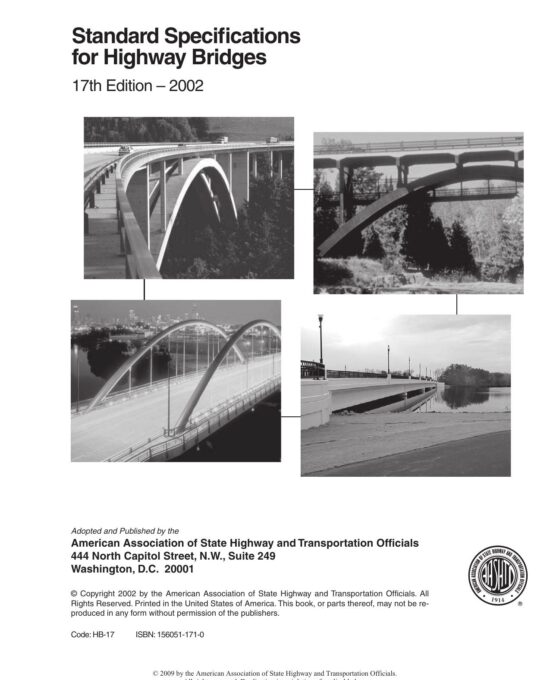
AASHTO HB-17: Standard Specifications for Highway Bridges, 17th Edition (2002)
AASHTO HB-17: Standard Specifications for Highway Bridges, 17th Edition (2002) provides comprehensive criteria for the design, construction, and maintenance of highway bridges throughout the United States. This edition is the final update prior to the nationwide adoption of Load and Resistance Factor Design (LRFD) standards.
Highlights:
- General provisions for bridge design, structural analysis, and performance
- Criteria for superstructures, substructures, abutments, culverts, and piers
- Service load and load factor design methods for concrete, steel, timber, and prestressed components
- Requirements for foundations, retaining structures, and soil-structure interaction
- Specifications addressing load distribution, fatigue, seismic considerations, and strength evaluation
- Commentary and notes incorporating interim revisions through 2003
- References to supporting standards from AASHTO, ASTM, AWS, and others
- Applicable to rehabilitation, legacy design validation, and maintenance planning for non-LRFD bridges
Who It’s For:
A critical reference for bridge engineers, transportation officials, and contractors working with legacy structures or evaluating designs developed before the transition to LRFD.
HB-17-2002
AASHTO HB-17: Standard Specifications for Highway Bridges, 17th Edition (2002)
AASHTO HB-17: Standard Specifications for Highway Bridges, 17th Edition (2002) provides comprehensive criteria for the design, construction, and maintenance of highway bridges throughout the United States. This edition is the final update prior to the nationwide adoption of Load and Resistance Factor Design (LRFD) standards.
Highlights:
- General provisions for bridge design, structural analysis, and performance
- Criteria for superstructures, substructures, abutments, culverts, and piers
- Service load and load factor design methods for concrete, steel, timber, and prestressed components
- Requirements for foundations, retaining structures, and soil-structure interaction
- Specifications addressing load distribution, fatigue, seismic considerations, and strength evaluation
- Commentary and notes incorporating interim revisions through 2003
- References to supporting standards from AASHTO, ASTM, AWS, and others
- Applicable to rehabilitation, legacy design validation, and maintenance planning for non-LRFD bridges
Who It’s For:
A critical reference for bridge engineers, transportation officials, and contractors working with legacy structures or evaluating designs developed before the transition to LRFD.
HB-17-2002
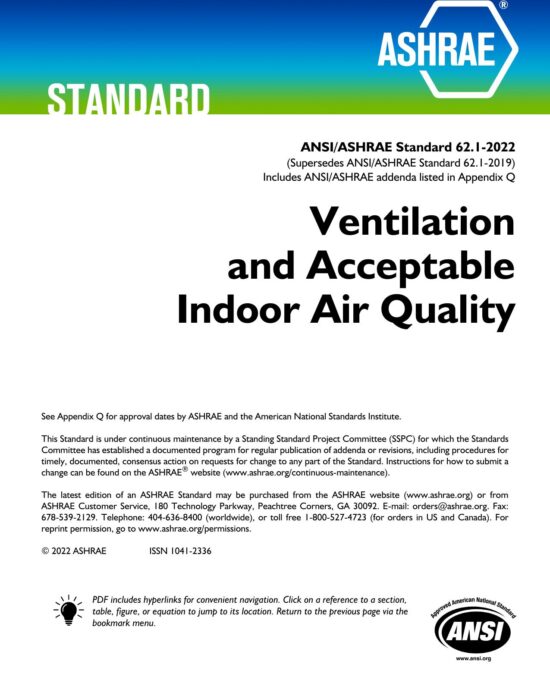
ANSI/ASHRAE 62.1-2022: Ventilation for Acceptable Indoor Air Quality
ANSI/ASHRAE Standard 62.1-2022: Ventilation for Acceptable Indoor Air Quality defines minimum requirements for mechanical and natural ventilation systems in commercial, institutional, and industrial buildings. Widely referenced by model codes such as the International Building Code, this standard is critical for achieving acceptable indoor air quality (IAQ) in non-residential environments.
Highlights:
- Defines procedures for assessing outdoor air quality and ventilation by occupancy type
- Revised Section 5 reorganizes systems/equipment content by airflow path
- Updates IAQ Procedure with design compound guidance and mass-balance modeling
- Establishes separation distances for exhaust air and dew point limits for cooled spaces
- Classifies ventilation zones and defines airflow effectiveness and breathing zone metrics
- Covers design, installation, commissioning, and maintenance of ventilation systems
- Includes appendices for healthcare settings, air quality evaluation, compliance paths, and simplified rate calculations
- Incorporates addenda through Appendix Q as part of its continuous maintenance model
Who It’s For:
Designed for mechanical engineers, HVAC professionals, code officials, and facility managers responsible for designing and maintaining compliant ventilation systems that promote occupant health and comfort.
ASHRAE 62.1-2022
ANSI/ASHRAE 62.1-2022: Ventilation for Acceptable Indoor Air Quality
ANSI/ASHRAE Standard 62.1-2022: Ventilation for Acceptable Indoor Air Quality defines minimum requirements for mechanical and natural ventilation systems in commercial, institutional, and industrial buildings. Widely referenced by model codes such as the International Building Code, this standard is critical for achieving acceptable indoor air quality (IAQ) in non-residential environments.
Highlights:
- Defines procedures for assessing outdoor air quality and ventilation by occupancy type
- Revised Section 5 reorganizes systems/equipment content by airflow path
- Updates IAQ Procedure with design compound guidance and mass-balance modeling
- Establishes separation distances for exhaust air and dew point limits for cooled spaces
- Classifies ventilation zones and defines airflow effectiveness and breathing zone metrics
- Covers design, installation, commissioning, and maintenance of ventilation systems
- Includes appendices for healthcare settings, air quality evaluation, compliance paths, and simplified rate calculations
- Incorporates addenda through Appendix Q as part of its continuous maintenance model
Who It’s For:
Designed for mechanical engineers, HVAC professionals, code officials, and facility managers responsible for designing and maintaining compliant ventilation systems that promote occupant health and comfort.
ASHRAE 62.1-2022