
ASME BPVC 2025 Section II, Part D (Metric): Properties of Materials
Original price was: $930.00.$310.00Current price is: $310.00.
The ASME BPVC 2025 Section II, Part D (Metric) provides mechanical and physical property data for materials listed in Parts A, B, and C. It includes values such as tensile strength, yield strength, modulus of elasticity, and thermal conductivity, presented in metric units. This section is an essential reference for engineers and designers who work primarily with SI-based standards.
The ASME BPVC 2025 Section II, Part D (Metric) provides mechanical and physical property data for materials listed in Parts A, B, and C. It includes values such as tensile strength, yield strength, modulus of elasticity, and thermal conductivity, presented in metric units. This section is an essential reference for engineers and designers who work primarily with SI-based standards.
Book information
Purchase now to read the book instantly.
Add to cartRelated products
AWS D17.3/D17.3M:2016 – Specification for Friction Stir Welding of Aluminum Alloys for Aerospace Applications
AWS D17.3/D17.3M:2016 establishes general requirements for the friction stir welding (FSW) of aluminum alloys in aerospace applications. It provides standardized procedures for the design, fabrication, qualification, and inspection of aerospace components joined using the FSW process.
Highlights:
- Design requirements for FSW joints in aerospace structures
- Qualification procedures for welders, operators, and welding procedures
- Approved base metal specifications and usage limitations
- Tooling, fixture, and FSW equipment setup requirements
- Fabrication guidelines for welding parameters and process control
- Visual and mechanical inspection methods for weld quality verification
- Acceptance criteria for discontinuities, mechanical properties, and visual appearance
- Quality assurance provisions, documentation, and recordkeeping standards
New in the 2016 Edition:
- Updates to reflect advancements in friction stir welding techniques and aerospace material performance
- Enhanced inspection and qualification procedures for improved compliance and reliability
- Supersedes AWS D17.3/D17.3M:2010
Who’s It For:
Aerospace engineers, quality professionals, and fabricators involved in the production or qualification of aluminum structures using friction stir welding.
AWS D17.3/D17.3M-2016
AWS D17.3/D17.3M:2016 – Specification for Friction Stir Welding of Aluminum Alloys for Aerospace Applications
AWS D17.3/D17.3M:2016 establishes general requirements for the friction stir welding (FSW) of aluminum alloys in aerospace applications. It provides standardized procedures for the design, fabrication, qualification, and inspection of aerospace components joined using the FSW process.
Highlights:
- Design requirements for FSW joints in aerospace structures
- Qualification procedures for welders, operators, and welding procedures
- Approved base metal specifications and usage limitations
- Tooling, fixture, and FSW equipment setup requirements
- Fabrication guidelines for welding parameters and process control
- Visual and mechanical inspection methods for weld quality verification
- Acceptance criteria for discontinuities, mechanical properties, and visual appearance
- Quality assurance provisions, documentation, and recordkeeping standards
New in the 2016 Edition:
- Updates to reflect advancements in friction stir welding techniques and aerospace material performance
- Enhanced inspection and qualification procedures for improved compliance and reliability
- Supersedes AWS D17.3/D17.3M:2010
Who’s It For:
Aerospace engineers, quality professionals, and fabricators involved in the production or qualification of aluminum structures using friction stir welding.
AWS D17.3/D17.3M-2016
2021 International Fire Code – IFC-2021
The 2021 International Fire Code® (IFC) establishes minimum fire safety standards for new and existing buildings, facilities, and operations. It covers fire prevention, life safety, hazardous materials, and responder protection, making it essential for jurisdictions managing building and fire code enforcement. Fully coordinated with the 2021 I-Codes, it supports a comprehensive regulatory framework.
Highlights:
- Adds fire safety provisions for industrial and non-industrial 3D printing (additive manufacturing)
- Regulates artificial combustible vegetation on rooftops and near buildings
- Expands emergency responder communication system requirements to newer technologies
- Clarifies sprinkler mandates for storage and sale of upholstered furniture and mattresses
- Requires sprinklers in open parking garages that exceed defined fire area thresholds
- Updates standards for installation and removal of energy storage systems (ESS)
- Introduces dedicated chapter for safe storage of distilled spirits and wines in barrels or casks
- Reinforces construction site fire safety with clear roles and planning protocols
Who It’s For:
Fire marshals, building officials, safety consultants, and facility managers responsible for fire code compliance and enforcement.
IFC-2021
2021 International Fire Code – IFC-2021
The 2021 International Fire Code® (IFC) establishes minimum fire safety standards for new and existing buildings, facilities, and operations. It covers fire prevention, life safety, hazardous materials, and responder protection, making it essential for jurisdictions managing building and fire code enforcement. Fully coordinated with the 2021 I-Codes, it supports a comprehensive regulatory framework.
Highlights:
- Adds fire safety provisions for industrial and non-industrial 3D printing (additive manufacturing)
- Regulates artificial combustible vegetation on rooftops and near buildings
- Expands emergency responder communication system requirements to newer technologies
- Clarifies sprinkler mandates for storage and sale of upholstered furniture and mattresses
- Requires sprinklers in open parking garages that exceed defined fire area thresholds
- Updates standards for installation and removal of energy storage systems (ESS)
- Introduces dedicated chapter for safe storage of distilled spirits and wines in barrels or casks
- Reinforces construction site fire safety with clear roles and planning protocols
Who It’s For:
Fire marshals, building officials, safety consultants, and facility managers responsible for fire code compliance and enforcement.
IFC-2021
ASME B31.3-2022: Process Piping
ASME B31.3-2022: Process Piping provides comprehensive engineering requirements for the design, materials, fabrication, examination, testing, and safety of process piping systems used in petroleum refineries, chemical plants, pharmaceutical facilities, textile plants, paper mills, and related processing plants and terminals. It is a vital code for ensuring piping integrity in high-pressure, high-temperature, and corrosive service environments.
Highlights:
- Applies to metallic and nonmetallic piping for chemicals, petroleum, natural gas, and related fluids
- Covers piping components: pipe, flanges, valves, gaskets, bolts, expansion joints, and supports
- Design criteria for internal pressure, sustained loads, displacement strains, and occasional loads
- Construction requirements including welding, brazing, bending, assembly, and material specifications
- Mandatory rules for examination, testing, inspection, and leak testing procedures
- Stress range reduction factors, flexibility analysis, and allowable stress values by material and temperature
- Qualification requirements for personnel, procedures, and fabrication documentation
- Integration with ASME Section IX for welding and ASME B31.1 for power piping interfaces
- Updated stress tables and revisions to weld design rules in para. 328.5.2
- Errata incorporated for clarity on strength tables and weld joint tolerances
Who It’s For:
Mechanical engineers, piping designers, fabricators, inspectors, and maintenance teams working on the safe and code-compliant construction and modification of process piping systems across industries.
B31.3-2022
ASME B31.3-2022: Process Piping
ASME B31.3-2022: Process Piping provides comprehensive engineering requirements for the design, materials, fabrication, examination, testing, and safety of process piping systems used in petroleum refineries, chemical plants, pharmaceutical facilities, textile plants, paper mills, and related processing plants and terminals. It is a vital code for ensuring piping integrity in high-pressure, high-temperature, and corrosive service environments.
Highlights:
- Applies to metallic and nonmetallic piping for chemicals, petroleum, natural gas, and related fluids
- Covers piping components: pipe, flanges, valves, gaskets, bolts, expansion joints, and supports
- Design criteria for internal pressure, sustained loads, displacement strains, and occasional loads
- Construction requirements including welding, brazing, bending, assembly, and material specifications
- Mandatory rules for examination, testing, inspection, and leak testing procedures
- Stress range reduction factors, flexibility analysis, and allowable stress values by material and temperature
- Qualification requirements for personnel, procedures, and fabrication documentation
- Integration with ASME Section IX for welding and ASME B31.1 for power piping interfaces
- Updated stress tables and revisions to weld design rules in para. 328.5.2
- Errata incorporated for clarity on strength tables and weld joint tolerances
Who It’s For:
Mechanical engineers, piping designers, fabricators, inspectors, and maintenance teams working on the safe and code-compliant construction and modification of process piping systems across industries.
B31.3-2022
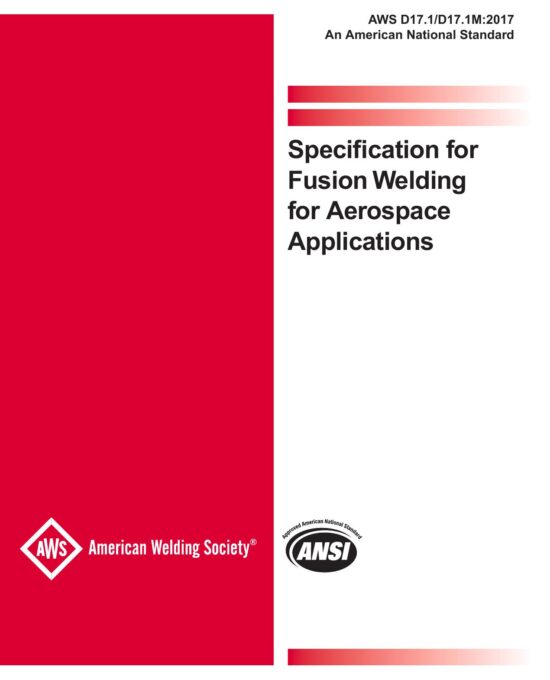
AWS D17.1/D17.1M:2017 – Specification for Fusion Welding for Aerospace Applications
AWS D17.1/D17.1M:2017 establishes the welding requirements for aircraft, aerospace, and space hardware using electric arc and high-energy beam fusion welding processes. It covers aluminum, nickel, iron, cobalt, titanium, and magnesium alloys and supports both flight-critical and support structure applications.
Highlights:
- Design criteria for aerospace weld joints
- Qualification requirements for procedures and personnel
- Fabrication, inspection, and acceptance standards
- Repair guidance for aerospace components
- Preweld/postweld processes including traceability and cleaning
- Visual and nondestructive exam methods with acceptance criteria
- Normative/informative annexes on bend tests, positions, acronyms, and forms
- Commentary with technical interpretation and best practices
New in the 2017 Edition:
- Annexes for UNS material designations
- Expanded welding position coverage and standardized forms
- Editorial updates for clarity and usability
Who’s It For:
Aerospace engineers, welding supervisors, inspectors, and quality professionals involved in the fabrication or evaluation of welded aerospace structures.
AWS D17.1/D17.1M-2017
AWS D17.1/D17.1M:2017 – Specification for Fusion Welding for Aerospace Applications
AWS D17.1/D17.1M:2017 establishes the welding requirements for aircraft, aerospace, and space hardware using electric arc and high-energy beam fusion welding processes. It covers aluminum, nickel, iron, cobalt, titanium, and magnesium alloys and supports both flight-critical and support structure applications.
Highlights:
- Design criteria for aerospace weld joints
- Qualification requirements for procedures and personnel
- Fabrication, inspection, and acceptance standards
- Repair guidance for aerospace components
- Preweld/postweld processes including traceability and cleaning
- Visual and nondestructive exam methods with acceptance criteria
- Normative/informative annexes on bend tests, positions, acronyms, and forms
- Commentary with technical interpretation and best practices
New in the 2017 Edition:
- Annexes for UNS material designations
- Expanded welding position coverage and standardized forms
- Editorial updates for clarity and usability
Who’s It For:
Aerospace engineers, welding supervisors, inspectors, and quality professionals involved in the fabrication or evaluation of welded aerospace structures.
AWS D17.1/D17.1M-2017