
ASME BPVC 2025 Section II, Part D (Customary): Properties of Materials
Original price was: $930.00.$310.00Current price is: $310.00.
The ASME BPVC 2025 Section II, Part D (Customary) provides mechanical and physical property data for materials listed in Parts A, B, and C. It includes values such as tensile strength, yield strength, modulus of elasticity, and thermal conductivity, presented in customary (U.S.) units. This section is an essential reference for engineers and designers who work with U.S. customary standards.
The ASME BPVC 2025 Section II, Part D (Customary) provides mechanical and physical property data for materials listed in Parts A, B, and C. It includes values such as tensile strength, yield strength, modulus of elasticity, and thermal conductivity, presented in customary (U.S.) units. This section is an essential reference for engineers and designers who work with U.S. customary standards.
Book information
Purchase now to read the book instantly.
Add to cartRelated products
2021 International Fire Code – IFC-2021
The 2021 International Fire Code® (IFC) establishes minimum fire safety standards for new and existing buildings, facilities, and operations. It covers fire prevention, life safety, hazardous materials, and responder protection, making it essential for jurisdictions managing building and fire code enforcement. Fully coordinated with the 2021 I-Codes, it supports a comprehensive regulatory framework.
Highlights:
- Adds fire safety provisions for industrial and non-industrial 3D printing (additive manufacturing)
- Regulates artificial combustible vegetation on rooftops and near buildings
- Expands emergency responder communication system requirements to newer technologies
- Clarifies sprinkler mandates for storage and sale of upholstered furniture and mattresses
- Requires sprinklers in open parking garages that exceed defined fire area thresholds
- Updates standards for installation and removal of energy storage systems (ESS)
- Introduces dedicated chapter for safe storage of distilled spirits and wines in barrels or casks
- Reinforces construction site fire safety with clear roles and planning protocols
Who It’s For:
Fire marshals, building officials, safety consultants, and facility managers responsible for fire code compliance and enforcement.
IFC-2021
2021 International Fire Code – IFC-2021
The 2021 International Fire Code® (IFC) establishes minimum fire safety standards for new and existing buildings, facilities, and operations. It covers fire prevention, life safety, hazardous materials, and responder protection, making it essential for jurisdictions managing building and fire code enforcement. Fully coordinated with the 2021 I-Codes, it supports a comprehensive regulatory framework.
Highlights:
- Adds fire safety provisions for industrial and non-industrial 3D printing (additive manufacturing)
- Regulates artificial combustible vegetation on rooftops and near buildings
- Expands emergency responder communication system requirements to newer technologies
- Clarifies sprinkler mandates for storage and sale of upholstered furniture and mattresses
- Requires sprinklers in open parking garages that exceed defined fire area thresholds
- Updates standards for installation and removal of energy storage systems (ESS)
- Introduces dedicated chapter for safe storage of distilled spirits and wines in barrels or casks
- Reinforces construction site fire safety with clear roles and planning protocols
Who It’s For:
Fire marshals, building officials, safety consultants, and facility managers responsible for fire code compliance and enforcement.
IFC-2021
ASME PTB-4-2021: ASME Section VIII – Division 1 Example Problem Manual
ASME PTB-4-2021: ASME Section VIII – Division 1 Example Problem Manual presents a comprehensive set of solved example problems demonstrating the correct application of design-by-rule methods from ASME Boiler and Pressure Vessel Code, Section VIII, Division 1. It serves as a valuable learning and reference tool for engineers, designers, and inspectors working in pressure vessel design and analysis.
Highlights:
- Step-by-step examples covering material selection, MDMT, welded joints, and reinforcement
- Calculations for internal/external pressure, flange design, tubesheets, and expansion joints
- Integration of Mandatory Appendix 46 for using Division 2 methods within Division 1 design
- Comparison of Division 1 and Division 2 approaches to selected design problems
- Commentary offering insight into code interpretation and design rationale
- Dual-unit presentation: U.S. Customary and SI
- Examples include postweld heat treatment, hydrotesting, out-of-roundness, and NDE procedures
- Supports design-by-rule and design-by-analysis education and application
Who It’s For:
Mechanical engineers, vessel designers, educators, and code compliance professionals seeking hands-on understanding and accurate application of ASME Section VIII, Division 1 requirements.
PTB-4-2021
ASME PTB-4-2021: ASME Section VIII – Division 1 Example Problem Manual
ASME PTB-4-2021: ASME Section VIII – Division 1 Example Problem Manual presents a comprehensive set of solved example problems demonstrating the correct application of design-by-rule methods from ASME Boiler and Pressure Vessel Code, Section VIII, Division 1. It serves as a valuable learning and reference tool for engineers, designers, and inspectors working in pressure vessel design and analysis.
Highlights:
- Step-by-step examples covering material selection, MDMT, welded joints, and reinforcement
- Calculations for internal/external pressure, flange design, tubesheets, and expansion joints
- Integration of Mandatory Appendix 46 for using Division 2 methods within Division 1 design
- Comparison of Division 1 and Division 2 approaches to selected design problems
- Commentary offering insight into code interpretation and design rationale
- Dual-unit presentation: U.S. Customary and SI
- Examples include postweld heat treatment, hydrotesting, out-of-roundness, and NDE procedures
- Supports design-by-rule and design-by-analysis education and application
Who It’s For:
Mechanical engineers, vessel designers, educators, and code compliance professionals seeking hands-on understanding and accurate application of ASME Section VIII, Division 1 requirements.
PTB-4-2021
ASME B31.3-2022: Process Piping
ASME B31.3-2022: Process Piping provides comprehensive engineering requirements for the design, materials, fabrication, examination, testing, and safety of process piping systems used in petroleum refineries, chemical plants, pharmaceutical facilities, textile plants, paper mills, and related processing plants and terminals. It is a vital code for ensuring piping integrity in high-pressure, high-temperature, and corrosive service environments.
Highlights:
- Applies to metallic and nonmetallic piping for chemicals, petroleum, natural gas, and related fluids
- Covers piping components: pipe, flanges, valves, gaskets, bolts, expansion joints, and supports
- Design criteria for internal pressure, sustained loads, displacement strains, and occasional loads
- Construction requirements including welding, brazing, bending, assembly, and material specifications
- Mandatory rules for examination, testing, inspection, and leak testing procedures
- Stress range reduction factors, flexibility analysis, and allowable stress values by material and temperature
- Qualification requirements for personnel, procedures, and fabrication documentation
- Integration with ASME Section IX for welding and ASME B31.1 for power piping interfaces
- Updated stress tables and revisions to weld design rules in para. 328.5.2
- Errata incorporated for clarity on strength tables and weld joint tolerances
Who It’s For:
Mechanical engineers, piping designers, fabricators, inspectors, and maintenance teams working on the safe and code-compliant construction and modification of process piping systems across industries.
B31.3-2022
ASME B31.3-2022: Process Piping
ASME B31.3-2022: Process Piping provides comprehensive engineering requirements for the design, materials, fabrication, examination, testing, and safety of process piping systems used in petroleum refineries, chemical plants, pharmaceutical facilities, textile plants, paper mills, and related processing plants and terminals. It is a vital code for ensuring piping integrity in high-pressure, high-temperature, and corrosive service environments.
Highlights:
- Applies to metallic and nonmetallic piping for chemicals, petroleum, natural gas, and related fluids
- Covers piping components: pipe, flanges, valves, gaskets, bolts, expansion joints, and supports
- Design criteria for internal pressure, sustained loads, displacement strains, and occasional loads
- Construction requirements including welding, brazing, bending, assembly, and material specifications
- Mandatory rules for examination, testing, inspection, and leak testing procedures
- Stress range reduction factors, flexibility analysis, and allowable stress values by material and temperature
- Qualification requirements for personnel, procedures, and fabrication documentation
- Integration with ASME Section IX for welding and ASME B31.1 for power piping interfaces
- Updated stress tables and revisions to weld design rules in para. 328.5.2
- Errata incorporated for clarity on strength tables and weld joint tolerances
Who It’s For:
Mechanical engineers, piping designers, fabricators, inspectors, and maintenance teams working on the safe and code-compliant construction and modification of process piping systems across industries.
B31.3-2022
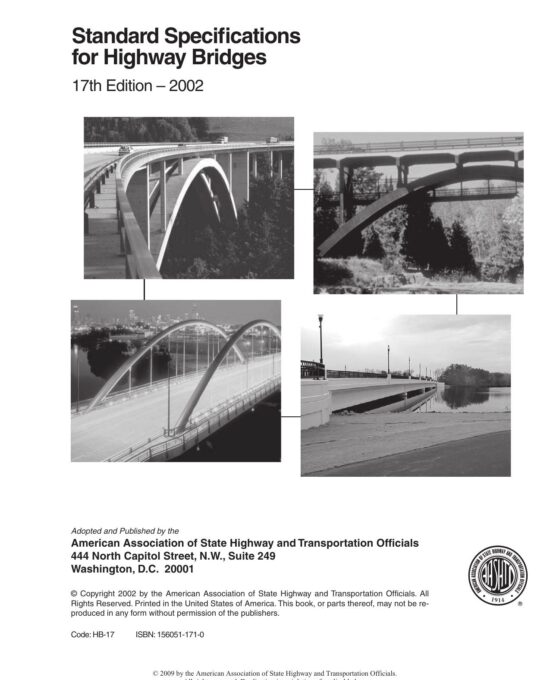
AASHTO HB-17: Standard Specifications for Highway Bridges, 17th Edition (2002)
AASHTO HB-17: Standard Specifications for Highway Bridges, 17th Edition (2002) provides comprehensive criteria for the design, construction, and maintenance of highway bridges throughout the United States. This edition is the final update prior to the nationwide adoption of Load and Resistance Factor Design (LRFD) standards.
Highlights:
- General provisions for bridge design, structural analysis, and performance
- Criteria for superstructures, substructures, abutments, culverts, and piers
- Service load and load factor design methods for concrete, steel, timber, and prestressed components
- Requirements for foundations, retaining structures, and soil-structure interaction
- Specifications addressing load distribution, fatigue, seismic considerations, and strength evaluation
- Commentary and notes incorporating interim revisions through 2003
- References to supporting standards from AASHTO, ASTM, AWS, and others
- Applicable to rehabilitation, legacy design validation, and maintenance planning for non-LRFD bridges
Who It’s For:
A critical reference for bridge engineers, transportation officials, and contractors working with legacy structures or evaluating designs developed before the transition to LRFD.
HB-17-2002
AASHTO HB-17: Standard Specifications for Highway Bridges, 17th Edition (2002)
AASHTO HB-17: Standard Specifications for Highway Bridges, 17th Edition (2002) provides comprehensive criteria for the design, construction, and maintenance of highway bridges throughout the United States. This edition is the final update prior to the nationwide adoption of Load and Resistance Factor Design (LRFD) standards.
Highlights:
- General provisions for bridge design, structural analysis, and performance
- Criteria for superstructures, substructures, abutments, culverts, and piers
- Service load and load factor design methods for concrete, steel, timber, and prestressed components
- Requirements for foundations, retaining structures, and soil-structure interaction
- Specifications addressing load distribution, fatigue, seismic considerations, and strength evaluation
- Commentary and notes incorporating interim revisions through 2003
- References to supporting standards from AASHTO, ASTM, AWS, and others
- Applicable to rehabilitation, legacy design validation, and maintenance planning for non-LRFD bridges
Who It’s For:
A critical reference for bridge engineers, transportation officials, and contractors working with legacy structures or evaluating designs developed before the transition to LRFD.
HB-17-2002