
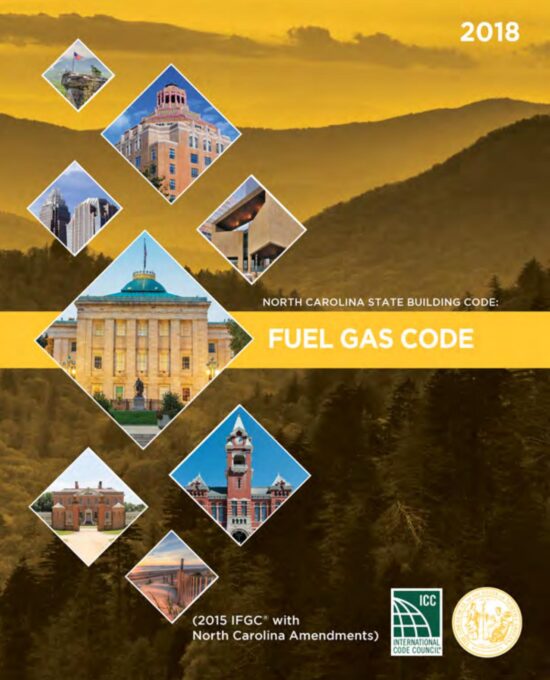
2018 North Carolina State Building Code: Fuel Gas Code (NCFGC-2018)
The 2018 North Carolina State Building Code: Fuel Gas Code (NCFGC) integrates the 2015 International Fuel Gas Code® with state-specific amendments to regulate the design, installation, maintenance, and inspection of fuel gas systems. It establishes safety standards for natural and LP-gas systems across residential and commercial buildings, excluding utility infrastructure upstream of the point of delivery.
This edition ensures compatibility with the full family of I-Codes® and emphasizes both prescriptive and performance-based approaches to address gas piping, appliances, combustion air, venting, and hydrogen systems. With clear administrative provisions and detailed technical criteria, it supports safe, efficient, and code-compliant fuel gas infrastructure statewide.
Highlights:
- Applies to natural gas (≤125 psig) and LP-gas (≤20 psig) systems
- Covers piping, shutoff valves, appliances, combustion air, and venting
- Chapter-based structure includes general regulations, appliance-specific criteria, and gaseous hydrogen provisions
- Aligns with mechanical and residential codes for crossover consistency
- Appendices provide gas pipe sizing, vent system design, and safety inspection procedures
- North Carolina-specific deletions and modifications for administrative sections
- Supports engineers, inspectors, and contractors through enforceable guidance
Who It’s For:
Mechanical contractors, design professionals, inspectors, and code officials in North Carolina responsible for safe installation and maintenance of gas piping and appliance systems in compliance with state-adopted standards.
NCFGC-2018
2018 North Carolina State Building Code: Fuel Gas Code (NCFGC-2018)
The 2018 North Carolina State Building Code: Fuel Gas Code (NCFGC) integrates the 2015 International Fuel Gas Code® with state-specific amendments to regulate the design, installation, maintenance, and inspection of fuel gas systems. It establishes safety standards for natural and LP-gas systems across residential and commercial buildings, excluding utility infrastructure upstream of the point of delivery.
This edition ensures compatibility with the full family of I-Codes® and emphasizes both prescriptive and performance-based approaches to address gas piping, appliances, combustion air, venting, and hydrogen systems. With clear administrative provisions and detailed technical criteria, it supports safe, efficient, and code-compliant fuel gas infrastructure statewide.
Highlights:
- Applies to natural gas (≤125 psig) and LP-gas (≤20 psig) systems
- Covers piping, shutoff valves, appliances, combustion air, and venting
- Chapter-based structure includes general regulations, appliance-specific criteria, and gaseous hydrogen provisions
- Aligns with mechanical and residential codes for crossover consistency
- Appendices provide gas pipe sizing, vent system design, and safety inspection procedures
- North Carolina-specific deletions and modifications for administrative sections
- Supports engineers, inspectors, and contractors through enforceable guidance
Who It’s For:
Mechanical contractors, design professionals, inspectors, and code officials in North Carolina responsible for safe installation and maintenance of gas piping and appliance systems in compliance with state-adopted standards.
NCFGC-2018
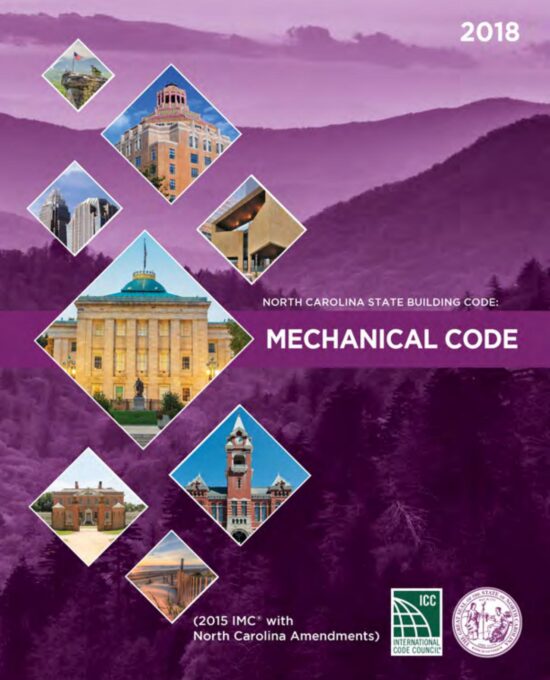
2018 North Carolina State Building Code: Mechanical Code
The 2018 North Carolina State Building Code: Mechanical Code (NCMC) incorporates the 2015 International Mechanical Code (IMC) with state-specific amendments. It sets forth minimum regulations for mechanical systems to ensure public safety, health, and welfare across residential, commercial, and institutional buildings. Covering HVAC, ventilation, combustion air, exhaust systems, hydronics, and solar thermal systems, this code supports both prescriptive and performance-based design approaches.
Highlights:
- Based on the 2015 IMC, enhanced by North Carolina-specific modifications
- Defines requirements for appliance venting, duct systems, chimneys, boilers, and solar thermal systems
- Prescriptive and performance-based methods for mechanical system compliance
- Comprehensive coverage of indoor air quality, exhaust controls, and refrigeration standards
- Integrates combustion air and fuel oil systems, with references to NFPA and related codes
- Includes specialized chapters on hydronic piping, fuel oil storage, and solar systems
- Organized to align with other North Carolina codes for seamless enforcement and application
- Incorporates ICC’s latest formatting and content structure with clear section annotations
Who It’s For:
Mechanical contractors, HVAC designers, code officials, and engineers in North Carolina engaged in the design, installation, inspection, and permitting of mechanical systems per the state building code.
NCMC-2018
2018 North Carolina State Building Code: Mechanical Code
The 2018 North Carolina State Building Code: Mechanical Code (NCMC) incorporates the 2015 International Mechanical Code (IMC) with state-specific amendments. It sets forth minimum regulations for mechanical systems to ensure public safety, health, and welfare across residential, commercial, and institutional buildings. Covering HVAC, ventilation, combustion air, exhaust systems, hydronics, and solar thermal systems, this code supports both prescriptive and performance-based design approaches.
Highlights:
- Based on the 2015 IMC, enhanced by North Carolina-specific modifications
- Defines requirements for appliance venting, duct systems, chimneys, boilers, and solar thermal systems
- Prescriptive and performance-based methods for mechanical system compliance
- Comprehensive coverage of indoor air quality, exhaust controls, and refrigeration standards
- Integrates combustion air and fuel oil systems, with references to NFPA and related codes
- Includes specialized chapters on hydronic piping, fuel oil storage, and solar systems
- Organized to align with other North Carolina codes for seamless enforcement and application
- Incorporates ICC’s latest formatting and content structure with clear section annotations
Who It’s For:
Mechanical contractors, HVAC designers, code officials, and engineers in North Carolina engaged in the design, installation, inspection, and permitting of mechanical systems per the state building code.
NCMC-2018