
ASME BPVC 2025 Section X: Fiber-Reinforced Plastic Pressure Vessels
Original price was: $609.00.$203.00Current price is: $203.00.
ASME BPVC 2025 Section X covers construction requirements for fiber-reinforced plastic (FRP) pressure vessels, including design bases, materials, fabrication, inspection, testing, and qualification by prototype testing (Classes I & III) or by mandatory design rules with nondestructive examination (Class II).
ASME BPVC 2025 Section X covers construction requirements for fiber-reinforced plastic (FRP) pressure vessels, including design bases, materials, fabrication, inspection, testing, and qualification by prototype testing (Classes I & III) or by mandatory design rules with nondestructive examination (Class II).
Book information
Purchase now to read the book instantly.
Add to cartRelated products
ANSI/ASHRAE 62.1-2022: Ventilation for Acceptable Indoor Air Quality
ANSI/ASHRAE Standard 62.1-2022: Ventilation for Acceptable Indoor Air Quality defines minimum requirements for mechanical and natural ventilation systems in commercial, institutional, and industrial buildings. Widely referenced by model codes such as the International Building Code, this standard is critical for achieving acceptable indoor air quality (IAQ) in non-residential environments.
Highlights:
- Defines procedures for assessing outdoor air quality and ventilation by occupancy type
- Revised Section 5 reorganizes systems/equipment content by airflow path
- Updates IAQ Procedure with design compound guidance and mass-balance modeling
- Establishes separation distances for exhaust air and dew point limits for cooled spaces
- Classifies ventilation zones and defines airflow effectiveness and breathing zone metrics
- Covers design, installation, commissioning, and maintenance of ventilation systems
- Includes appendices for healthcare settings, air quality evaluation, compliance paths, and simplified rate calculations
- Incorporates addenda through Appendix Q as part of its continuous maintenance model
Who It’s For:
Designed for mechanical engineers, HVAC professionals, code officials, and facility managers responsible for designing and maintaining compliant ventilation systems that promote occupant health and comfort.
ASHRAE 62.1-2022
ANSI/ASHRAE 62.1-2022: Ventilation for Acceptable Indoor Air Quality
ANSI/ASHRAE Standard 62.1-2022: Ventilation for Acceptable Indoor Air Quality defines minimum requirements for mechanical and natural ventilation systems in commercial, institutional, and industrial buildings. Widely referenced by model codes such as the International Building Code, this standard is critical for achieving acceptable indoor air quality (IAQ) in non-residential environments.
Highlights:
- Defines procedures for assessing outdoor air quality and ventilation by occupancy type
- Revised Section 5 reorganizes systems/equipment content by airflow path
- Updates IAQ Procedure with design compound guidance and mass-balance modeling
- Establishes separation distances for exhaust air and dew point limits for cooled spaces
- Classifies ventilation zones and defines airflow effectiveness and breathing zone metrics
- Covers design, installation, commissioning, and maintenance of ventilation systems
- Includes appendices for healthcare settings, air quality evaluation, compliance paths, and simplified rate calculations
- Incorporates addenda through Appendix Q as part of its continuous maintenance model
Who It’s For:
Designed for mechanical engineers, HVAC professionals, code officials, and facility managers responsible for designing and maintaining compliant ventilation systems that promote occupant health and comfort.
ASHRAE 62.1-2022
API 650: Welded Tanks for Oil Storage, 13th Edition (2020)
API 650: Welded Tanks for Oil Storage, 13th Edition (2020) sets the standard for the design, construction, and inspection of vertical, cylindrical, aboveground welded storage tanks operating near atmospheric pressure. Intended for non-refrigerated service up to 93°C (200°F), this specification is essential for tanks used in the storage of petroleum, chemicals, and other liquid products.
Highlights:
- Covers open-top and closed-top tank design for a wide range of capacities
- Allows construction using carbon steel, stainless steel, and duplex steel materials
- Specifies requirements for shell, bottom, roof, nozzle components, and structural supports
- Provides detailed material selection guidance and limits for plates, flanges, and welding consumables
- Defines procedures for welding, welder qualification, and weld inspection
- Includes standards for erection, hydrostatic testing, tolerances, and repair methods
- Annexes address specialized applications:
- Seismic design (Annex E)
- Floating roofs (Annexes C and H)
- Aluminum and stainless steel tanks (Annexes AL and S)
- Elevated temperature service (Annex M)
- Leak detection, under-bottom connections (Annexes I and O)
- API Monogram licensing (Annex Y)
Who It’s For:
A critical reference for storage tank engineers, fabricators, inspectors, and facility operators involved in tank design, procurement, fabrication, and field erection in the oil, gas, chemical, and industrial sectors.
API 650-2020
API 650: Welded Tanks for Oil Storage, 13th Edition (2020)
API 650: Welded Tanks for Oil Storage, 13th Edition (2020) sets the standard for the design, construction, and inspection of vertical, cylindrical, aboveground welded storage tanks operating near atmospheric pressure. Intended for non-refrigerated service up to 93°C (200°F), this specification is essential for tanks used in the storage of petroleum, chemicals, and other liquid products.
Highlights:
- Covers open-top and closed-top tank design for a wide range of capacities
- Allows construction using carbon steel, stainless steel, and duplex steel materials
- Specifies requirements for shell, bottom, roof, nozzle components, and structural supports
- Provides detailed material selection guidance and limits for plates, flanges, and welding consumables
- Defines procedures for welding, welder qualification, and weld inspection
- Includes standards for erection, hydrostatic testing, tolerances, and repair methods
- Annexes address specialized applications:
- Seismic design (Annex E)
- Floating roofs (Annexes C and H)
- Aluminum and stainless steel tanks (Annexes AL and S)
- Elevated temperature service (Annex M)
- Leak detection, under-bottom connections (Annexes I and O)
- API Monogram licensing (Annex Y)
Who It’s For:
A critical reference for storage tank engineers, fabricators, inspectors, and facility operators involved in tank design, procurement, fabrication, and field erection in the oil, gas, chemical, and industrial sectors.
API 650-2020
2021 International Fire Code – IFC-2021
The 2021 International Fire Code® (IFC) establishes minimum fire safety standards for new and existing buildings, facilities, and operations. It covers fire prevention, life safety, hazardous materials, and responder protection, making it essential for jurisdictions managing building and fire code enforcement. Fully coordinated with the 2021 I-Codes, it supports a comprehensive regulatory framework.
Highlights:
- Adds fire safety provisions for industrial and non-industrial 3D printing (additive manufacturing)
- Regulates artificial combustible vegetation on rooftops and near buildings
- Expands emergency responder communication system requirements to newer technologies
- Clarifies sprinkler mandates for storage and sale of upholstered furniture and mattresses
- Requires sprinklers in open parking garages that exceed defined fire area thresholds
- Updates standards for installation and removal of energy storage systems (ESS)
- Introduces dedicated chapter for safe storage of distilled spirits and wines in barrels or casks
- Reinforces construction site fire safety with clear roles and planning protocols
Who It’s For:
Fire marshals, building officials, safety consultants, and facility managers responsible for fire code compliance and enforcement.
IFC-2021
2021 International Fire Code – IFC-2021
The 2021 International Fire Code® (IFC) establishes minimum fire safety standards for new and existing buildings, facilities, and operations. It covers fire prevention, life safety, hazardous materials, and responder protection, making it essential for jurisdictions managing building and fire code enforcement. Fully coordinated with the 2021 I-Codes, it supports a comprehensive regulatory framework.
Highlights:
- Adds fire safety provisions for industrial and non-industrial 3D printing (additive manufacturing)
- Regulates artificial combustible vegetation on rooftops and near buildings
- Expands emergency responder communication system requirements to newer technologies
- Clarifies sprinkler mandates for storage and sale of upholstered furniture and mattresses
- Requires sprinklers in open parking garages that exceed defined fire area thresholds
- Updates standards for installation and removal of energy storage systems (ESS)
- Introduces dedicated chapter for safe storage of distilled spirits and wines in barrels or casks
- Reinforces construction site fire safety with clear roles and planning protocols
Who It’s For:
Fire marshals, building officials, safety consultants, and facility managers responsible for fire code compliance and enforcement.
IFC-2021
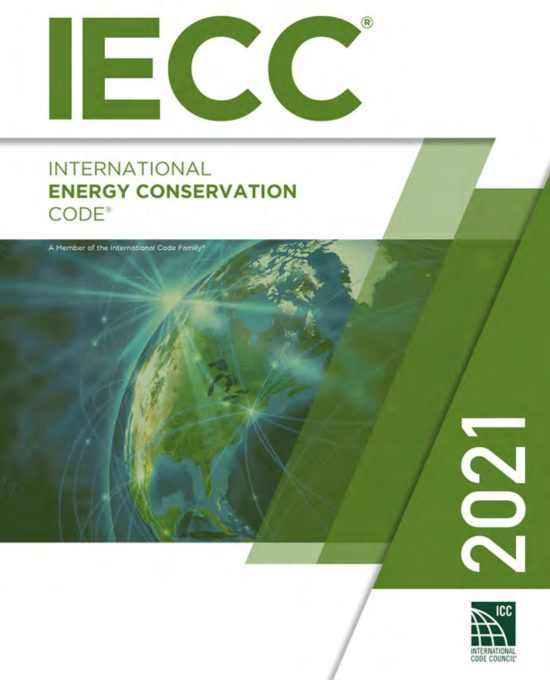
2021 International Energy Conservation Code – IECC-2021
The 2021 International Energy Conservation Code® (IECC) sets the baseline for energy-efficient design and construction of new buildings, as well as additions and alterations to existing residential and commercial structures. It features separate residential and commercial provisions and is fully integrated with the 2021 I-Codes for coordinated compliance.
Highlights:
- Divides content into Residential (≤3 stories) and Commercial sections for targeted regulation
- Includes multiple compliance paths: prescriptive, performance-based, and Energy Rating Index (ERI)
- Updated climate zone data affects insulation and system efficiency by region
- New requirements for air barriers, insulation materials, and fenestration U-factor/SHGC
- Enhanced HVAC efficiency standards and ventilation control requirements
- Revised lighting power limits, daylighting controls, and sensor use for commercial spaces
- Strengthened water heating system insulation and controls for energy savings
- Specific provisions for renovations, historic buildings, and changes in use
- Expanded commissioning requirements and documentation protocols
- Optional appendices for solar-ready design and zero energy building frameworks
Who It’s For:
Architects, energy consultants, engineers, and code officials seeking to meet energy efficiency standards for code-compliant, sustainable buildings.
IECC-2021
2021 International Energy Conservation Code – IECC-2021
The 2021 International Energy Conservation Code® (IECC) sets the baseline for energy-efficient design and construction of new buildings, as well as additions and alterations to existing residential and commercial structures. It features separate residential and commercial provisions and is fully integrated with the 2021 I-Codes for coordinated compliance.
Highlights:
- Divides content into Residential (≤3 stories) and Commercial sections for targeted regulation
- Includes multiple compliance paths: prescriptive, performance-based, and Energy Rating Index (ERI)
- Updated climate zone data affects insulation and system efficiency by region
- New requirements for air barriers, insulation materials, and fenestration U-factor/SHGC
- Enhanced HVAC efficiency standards and ventilation control requirements
- Revised lighting power limits, daylighting controls, and sensor use for commercial spaces
- Strengthened water heating system insulation and controls for energy savings
- Specific provisions for renovations, historic buildings, and changes in use
- Expanded commissioning requirements and documentation protocols
- Optional appendices for solar-ready design and zero energy building frameworks
Who It’s For:
Architects, energy consultants, engineers, and code officials seeking to meet energy efficiency standards for code-compliant, sustainable buildings.
IECC-2021