
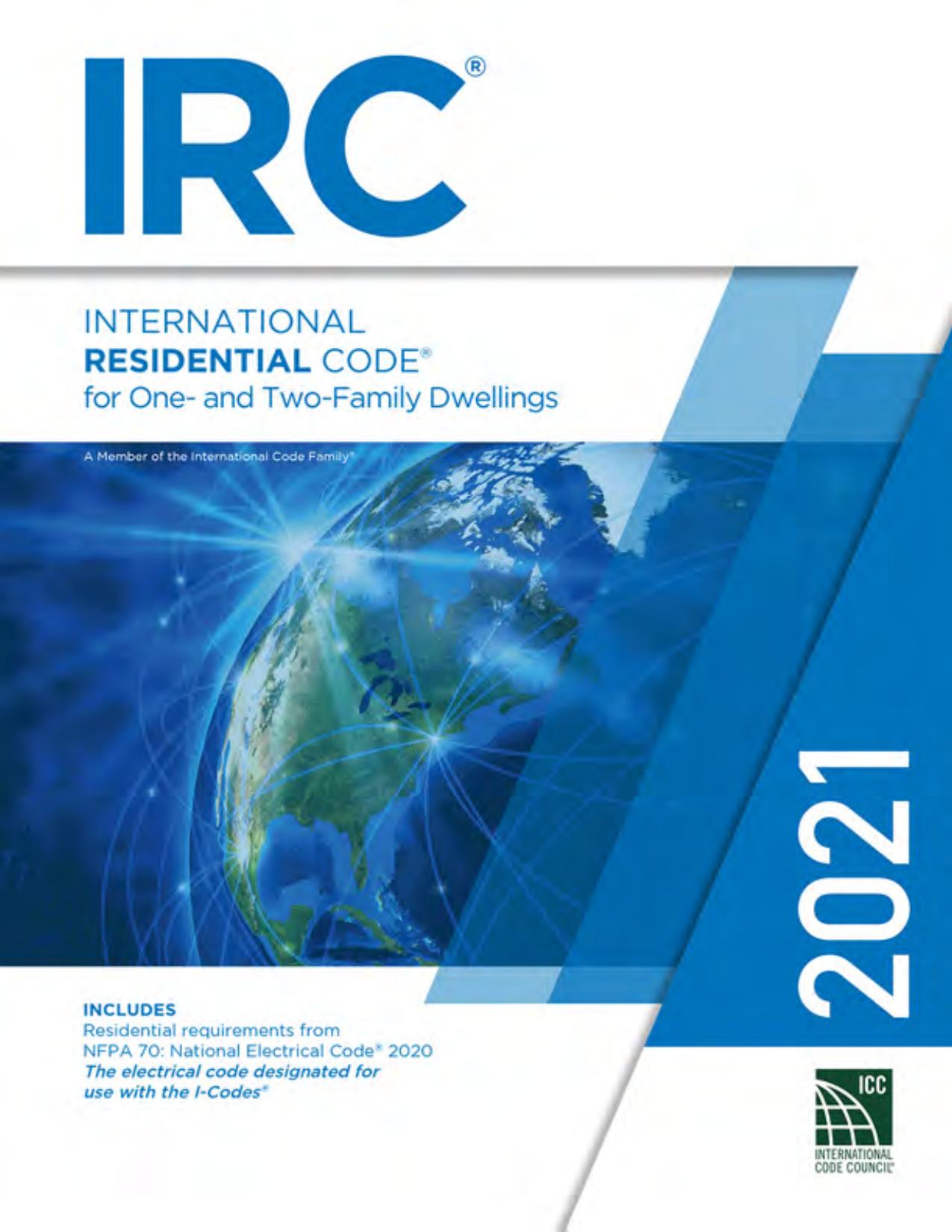
2021 International Residential Code for One- and Two-Family Dwellings – IRC-2021
Original price was: $60.00.$37.00Current price is: $37.00.
The 2021 International Residential Code® (IRC) sets minimum requirements for one- and two-family dwellings and townhouses up to three stories. This official ICC model code consolidates building, mechanical, plumbing, energy, fuel gas, and electrical standards into one unified guide for home construction compliance.
Highlights:
- Covers structural, mechanical, plumbing, HVAC, energy, and electrical systems
- Offers both prescriptive rules and performance-based design flexibility
- Aligns with 2021 I-Codes® for integrated, multi-discipline compliance
- Includes updated energy provisions (NFPA 70, IECC) and appendices for solar, radon, and 3D-printed construction
Who It’s For:
Builders, code officials, engineers, and inspectors involved in residential code compliance, permitting, inspection preparation, or professional reference.
IRC-2021
The 2021 International Residential Code® (IRC) sets minimum requirements for one- and two-family dwellings and townhouses up to three stories. This official ICC model code consolidates building, mechanical, plumbing, energy, fuel gas, and electrical standards into one unified guide for home construction compliance.
Highlights:
- Covers structural, mechanical, plumbing, HVAC, energy, and electrical systems
- Offers both prescriptive rules and performance-based design flexibility
- Aligns with 2021 I-Codes® for integrated, multi-discipline compliance
- Includes updated energy provisions (NFPA 70, IECC) and appendices for solar, radon, and 3D-printed construction
Who It’s For:
Builders, code officials, engineers, and inspectors involved in residential code compliance, permitting, inspection preparation, or professional reference.
IRC-2021
Book information
Purchase now to read the book instantly.
Add to cartRelated products
ASME PTB-4-2021: ASME Section VIII – Division 1 Example Problem Manual
ASME PTB-4-2021: ASME Section VIII – Division 1 Example Problem Manual presents a comprehensive set of solved example problems demonstrating the correct application of design-by-rule methods from ASME Boiler and Pressure Vessel Code, Section VIII, Division 1. It serves as a valuable learning and reference tool for engineers, designers, and inspectors working in pressure vessel design and analysis.
Highlights:
- Step-by-step examples covering material selection, MDMT, welded joints, and reinforcement
- Calculations for internal/external pressure, flange design, tubesheets, and expansion joints
- Integration of Mandatory Appendix 46 for using Division 2 methods within Division 1 design
- Comparison of Division 1 and Division 2 approaches to selected design problems
- Commentary offering insight into code interpretation and design rationale
- Dual-unit presentation: U.S. Customary and SI
- Examples include postweld heat treatment, hydrotesting, out-of-roundness, and NDE procedures
- Supports design-by-rule and design-by-analysis education and application
Who It’s For:
Mechanical engineers, vessel designers, educators, and code compliance professionals seeking hands-on understanding and accurate application of ASME Section VIII, Division 1 requirements.
PTB-4-2021
ASME PTB-4-2021: ASME Section VIII – Division 1 Example Problem Manual
ASME PTB-4-2021: ASME Section VIII – Division 1 Example Problem Manual presents a comprehensive set of solved example problems demonstrating the correct application of design-by-rule methods from ASME Boiler and Pressure Vessel Code, Section VIII, Division 1. It serves as a valuable learning and reference tool for engineers, designers, and inspectors working in pressure vessel design and analysis.
Highlights:
- Step-by-step examples covering material selection, MDMT, welded joints, and reinforcement
- Calculations for internal/external pressure, flange design, tubesheets, and expansion joints
- Integration of Mandatory Appendix 46 for using Division 2 methods within Division 1 design
- Comparison of Division 1 and Division 2 approaches to selected design problems
- Commentary offering insight into code interpretation and design rationale
- Dual-unit presentation: U.S. Customary and SI
- Examples include postweld heat treatment, hydrotesting, out-of-roundness, and NDE procedures
- Supports design-by-rule and design-by-analysis education and application
Who It’s For:
Mechanical engineers, vessel designers, educators, and code compliance professionals seeking hands-on understanding and accurate application of ASME Section VIII, Division 1 requirements.
PTB-4-2021
AWS D1.6/D1.6M:2017 – Structural Welding Code – Stainless Steel
AWS D1.6/D1.6M:2017 – Structural Welding Code – Stainless Steel defines the welding requirements for austenitic and ferritic stainless steel structural components. Applicable to both shop and field fabrication, it governs the construction of non-pressure stainless steel structures and aligns closely with AWS D1.1 formatting for consistency.
Highlights:
- Design provisions for welded joints and structural connection details
- Specifications for base metals, filler materials, and qualified welding processes
- Prequalification criteria for procedures and joint configurations
- Qualification standards for welding procedures, welders, and operators
- Visual and nondestructive inspection methods
- Stud welding practices and performance qualification requirements
- Fabrication standards for cleaning, joint prep, and weld profile control
- Weld acceptance criteria and repair guidelines
- Normative and informative annexes on weld sizing, filler metal selection, sample forms, and macroetchants
- Commentary section offering interpretation and application guidance
Who It’s For:
Essential for fabricators, engineers, inspectors, and contractors involved in stainless steel construction for structural applications such as architectural systems, industrial frameworks, and corrosion-resistant environments.
AWS D1.6/D1.6M:2017
AWS D1.6/D1.6M:2017 – Structural Welding Code – Stainless Steel
AWS D1.6/D1.6M:2017 – Structural Welding Code – Stainless Steel defines the welding requirements for austenitic and ferritic stainless steel structural components. Applicable to both shop and field fabrication, it governs the construction of non-pressure stainless steel structures and aligns closely with AWS D1.1 formatting for consistency.
Highlights:
- Design provisions for welded joints and structural connection details
- Specifications for base metals, filler materials, and qualified welding processes
- Prequalification criteria for procedures and joint configurations
- Qualification standards for welding procedures, welders, and operators
- Visual and nondestructive inspection methods
- Stud welding practices and performance qualification requirements
- Fabrication standards for cleaning, joint prep, and weld profile control
- Weld acceptance criteria and repair guidelines
- Normative and informative annexes on weld sizing, filler metal selection, sample forms, and macroetchants
- Commentary section offering interpretation and application guidance
Who It’s For:
Essential for fabricators, engineers, inspectors, and contractors involved in stainless steel construction for structural applications such as architectural systems, industrial frameworks, and corrosion-resistant environments.
AWS D1.6/D1.6M:2017
ASME B31.3-2022: Process Piping
ASME B31.3-2022: Process Piping provides comprehensive engineering requirements for the design, materials, fabrication, examination, testing, and safety of process piping systems used in petroleum refineries, chemical plants, pharmaceutical facilities, textile plants, paper mills, and related processing plants and terminals. It is a vital code for ensuring piping integrity in high-pressure, high-temperature, and corrosive service environments.
Highlights:
- Applies to metallic and nonmetallic piping for chemicals, petroleum, natural gas, and related fluids
- Covers piping components: pipe, flanges, valves, gaskets, bolts, expansion joints, and supports
- Design criteria for internal pressure, sustained loads, displacement strains, and occasional loads
- Construction requirements including welding, brazing, bending, assembly, and material specifications
- Mandatory rules for examination, testing, inspection, and leak testing procedures
- Stress range reduction factors, flexibility analysis, and allowable stress values by material and temperature
- Qualification requirements for personnel, procedures, and fabrication documentation
- Integration with ASME Section IX for welding and ASME B31.1 for power piping interfaces
- Updated stress tables and revisions to weld design rules in para. 328.5.2
- Errata incorporated for clarity on strength tables and weld joint tolerances
Who It’s For:
Mechanical engineers, piping designers, fabricators, inspectors, and maintenance teams working on the safe and code-compliant construction and modification of process piping systems across industries.
B31.3-2022
ASME B31.3-2022: Process Piping
ASME B31.3-2022: Process Piping provides comprehensive engineering requirements for the design, materials, fabrication, examination, testing, and safety of process piping systems used in petroleum refineries, chemical plants, pharmaceutical facilities, textile plants, paper mills, and related processing plants and terminals. It is a vital code for ensuring piping integrity in high-pressure, high-temperature, and corrosive service environments.
Highlights:
- Applies to metallic and nonmetallic piping for chemicals, petroleum, natural gas, and related fluids
- Covers piping components: pipe, flanges, valves, gaskets, bolts, expansion joints, and supports
- Design criteria for internal pressure, sustained loads, displacement strains, and occasional loads
- Construction requirements including welding, brazing, bending, assembly, and material specifications
- Mandatory rules for examination, testing, inspection, and leak testing procedures
- Stress range reduction factors, flexibility analysis, and allowable stress values by material and temperature
- Qualification requirements for personnel, procedures, and fabrication documentation
- Integration with ASME Section IX for welding and ASME B31.1 for power piping interfaces
- Updated stress tables and revisions to weld design rules in para. 328.5.2
- Errata incorporated for clarity on strength tables and weld joint tolerances
Who It’s For:
Mechanical engineers, piping designers, fabricators, inspectors, and maintenance teams working on the safe and code-compliant construction and modification of process piping systems across industries.
B31.3-2022
ASCE 24-14: Flood Resistant Design and Construction, 2014
ASCE 24-14: Flood Resistant Design and Construction provides minimum requirements for the planning, design, and construction of buildings in flood-prone areas. Referenced by the International Building Code (IBC) and the National Flood Insurance Program (NFIP), this standard supports floodplain management regulations and promotes resilience through engineering best practices.
Highlights:
- Defines Flood Design Class (1–4) to guide risk-based design criteria
- Specifies elevation requirements based on flood hazard zones, building type, and occupancy
- Includes wet and dry floodproofing methods for commercial and residential applications
- Updates flood opening requirements including engineered vent systems and louvers
- Provides structural design standards for Coastal A Zones and coastal high hazard areas
- Identifies acceptable flood damage-resistant materials and construction techniques
- Covers tanks, utilities, egress, garages, and parking structures in flood-prone zones
- Offers guidance for substantial improvements and retrofitting of existing buildings
- Coordinates with ASCE 7 and NFIP regulations to ensure code consistency and compliance
Who It’s For:
Essential for civil engineers, architects, code officials, and builders involved in flood zone development, permitting, and compliance with FEMA, IBC, and local floodplain standards.
ASCE 24-2014
ASCE 24-14: Flood Resistant Design and Construction, 2014
ASCE 24-14: Flood Resistant Design and Construction provides minimum requirements for the planning, design, and construction of buildings in flood-prone areas. Referenced by the International Building Code (IBC) and the National Flood Insurance Program (NFIP), this standard supports floodplain management regulations and promotes resilience through engineering best practices.
Highlights:
- Defines Flood Design Class (1–4) to guide risk-based design criteria
- Specifies elevation requirements based on flood hazard zones, building type, and occupancy
- Includes wet and dry floodproofing methods for commercial and residential applications
- Updates flood opening requirements including engineered vent systems and louvers
- Provides structural design standards for Coastal A Zones and coastal high hazard areas
- Identifies acceptable flood damage-resistant materials and construction techniques
- Covers tanks, utilities, egress, garages, and parking structures in flood-prone zones
- Offers guidance for substantial improvements and retrofitting of existing buildings
- Coordinates with ASCE 7 and NFIP regulations to ensure code consistency and compliance
Who It’s For:
Essential for civil engineers, architects, code officials, and builders involved in flood zone development, permitting, and compliance with FEMA, IBC, and local floodplain standards.
ASCE 24-2014